(click link to watch)
The Book Thief by Markus Zusak
Book Blog for the Academic Challenge Program
Monday, August 4, 2014
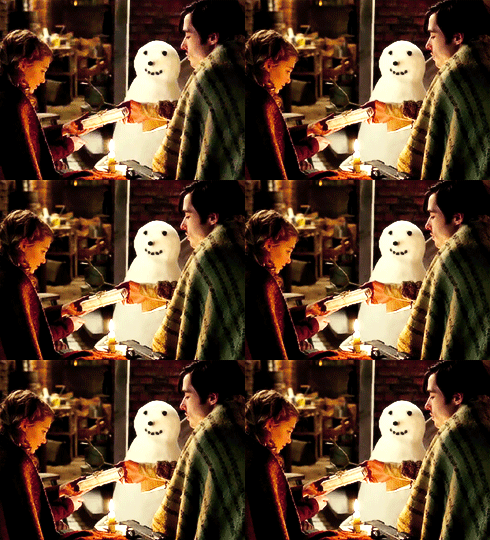
The Snowman Scene - The Book Thief Movie Clip
Easily one of my favorite parts of the book is the Snowman Scene with Liesel and Max, and eventually, Hans and Rosa.
Entry #3
I wanted to discuss one think in particular that I've noticed while reading The Book Thief.
I think Markus Zusak is a brilliant writer, and I think is writing style is interesting and new. Take this passage from page 395 for example:
"'Oh my God, Liesel, what have I done?"
Yes.
I must agree.
What had Papa done?"
The punctuation is pretty choppy throughout the book, especially in tense situations. I think it's meant to represent the way humans think.
When humans are put into situations where they may be in some sort of danger, the first response is to panic. It's instinct. Our thoughts get choppy and rushed as adrenaline courses through out veins. We tend to switch to a different thought before we've even completed the first one. I believe that it the message Zusak is trying to get across.
However, I also want to note that while it may be interesting and different, sometimes his style of writing is very hard to understand. For example, in the sub-chapter "Dominoes and Darkness," Rudy is, from what I understand, selected to attend an elite school for Hitler Youth. The way the sub-chapter is written conveys Rudy's understanding of the whole idea pretty clearly. But I also had to read over some parts several times before I understood what was going on.
All in all, there are going to be pros and cons to every book. While Zusak's book is genius and beautiful, it can be hard to understand at certain points. No book is perfect, and that is okay.
I think Markus Zusak is a brilliant writer, and I think is writing style is interesting and new. Take this passage from page 395 for example:
"'Oh my God, Liesel, what have I done?"
Yes.
I must agree.
What had Papa done?"
The punctuation is pretty choppy throughout the book, especially in tense situations. I think it's meant to represent the way humans think.
When humans are put into situations where they may be in some sort of danger, the first response is to panic. It's instinct. Our thoughts get choppy and rushed as adrenaline courses through out veins. We tend to switch to a different thought before we've even completed the first one. I believe that it the message Zusak is trying to get across.
However, I also want to note that while it may be interesting and different, sometimes his style of writing is very hard to understand. For example, in the sub-chapter "Dominoes and Darkness," Rudy is, from what I understand, selected to attend an elite school for Hitler Youth. The way the sub-chapter is written conveys Rudy's understanding of the whole idea pretty clearly. But I also had to read over some parts several times before I understood what was going on.
All in all, there are going to be pros and cons to every book. While Zusak's book is genius and beautiful, it can be hard to understand at certain points. No book is perfect, and that is okay.
Tuesday, July 29, 2014
Entry #2
"When she came to write her story, she would wonder exactly when the books and the words started to mean not just something, but everything." -page 30
"She was a girl. In Nazi Germany.
How fitting that she was discovering the power of words." -page 147
There is a comfort in books, words, and the characters within those words, that nothing can compare to. Words can numb your mind to the reality of existence or open your eyes to the parts of reality you failed to notice before. Words can start wars, and they can end them. Words can break things, and they can put things back together. Words can shape lives. Even on the brink of war, Liesel discovers that words can create peace. Growing up in a world that is full of hate, she is drawn to the peace and love and clarity that words can make someone feel. But she is also drawn to the dangerous adventure of actually stealing the books. Liesel's living an adventure story all her own.
One thing I love about The Book Thief is that it makes me, as a reader, forget I'm actually reading and instead I feel like I'm living with Liesel. Some books are a hassle to read, because it feels like I have to work to enjoy the story. Reading The Book Thief is like stepping into a completely different world. When I stop reading, it sticks with me. When I learn a lesson in a book, that lesson tends to stay with me in real life. Books can teach you lots of things if you let them.
"She was a girl. In Nazi Germany.
How fitting that she was discovering the power of words." -page 147
There is a comfort in books, words, and the characters within those words, that nothing can compare to. Words can numb your mind to the reality of existence or open your eyes to the parts of reality you failed to notice before. Words can start wars, and they can end them. Words can break things, and they can put things back together. Words can shape lives. Even on the brink of war, Liesel discovers that words can create peace. Growing up in a world that is full of hate, she is drawn to the peace and love and clarity that words can make someone feel. But she is also drawn to the dangerous adventure of actually stealing the books. Liesel's living an adventure story all her own.
One thing I love about The Book Thief is that it makes me, as a reader, forget I'm actually reading and instead I feel like I'm living with Liesel. Some books are a hassle to read, because it feels like I have to work to enjoy the story. Reading The Book Thief is like stepping into a completely different world. When I stop reading, it sticks with me. When I learn a lesson in a book, that lesson tends to stay with me in real life. Books can teach you lots of things if you let them.
Wednesday, July 16, 2014
Thursday, July 3, 2014
Entry #1
"Mistakes, mistakes, it's all I seem capable of at times."
- Death, page 23
A lot of authors don't pay enough attention to death in their stories. When a character dies, most authors either a.) pull one of those "...and then they died. That's it." moments on us, b.) give us the most disgustingly gory, medieval-torture deaths, or c.) turn all the other characters into sappy, sobbing messes and write eight chapters about that particular character's funeral. People don't think about death much, unless, of course, they're dying.
It's rare to find a book that isn't focused so much on a character dying, but on Death himself. Death is a physical thing, the body shutting down, for all things, human or not. But Death, the person, is a human concept. In the few books I've read that actually feature Death among the rotating cast of characters, he is portrayed as a dark, gloomy shadow sent to collect the souls of the dead and make the living characters lives miserable. I think that what people forget is that Death is so astoundingly human. We have funerals to give a feeling of peace to the living relatives and friends of the dead. We mourn, we grieve, we wonder about an afterlife. We entertain the idea that one day, we will see our deceased loved ones again.
Zusak's idea of Death is different. Death is not the sad creature that watches until a soul needs to be taken. He is curious, hardworking, and selfish, much like a human being. I think that his fascination with Liesel is meant to show the readers how he has the curiosity of a human. With that curiosity comes selfishness, wanting more and more of human experience for himself.
This quote stuck out to me because humans are always so hung up on their mistakes. We focus so much on the things we do wrong, it's hard to enjoy the life we've got while we've got it.
- Death, page 23
A lot of authors don't pay enough attention to death in their stories. When a character dies, most authors either a.) pull one of those "...and then they died. That's it." moments on us, b.) give us the most disgustingly gory, medieval-torture deaths, or c.) turn all the other characters into sappy, sobbing messes and write eight chapters about that particular character's funeral. People don't think about death much, unless, of course, they're dying.
It's rare to find a book that isn't focused so much on a character dying, but on Death himself. Death is a physical thing, the body shutting down, for all things, human or not. But Death, the person, is a human concept. In the few books I've read that actually feature Death among the rotating cast of characters, he is portrayed as a dark, gloomy shadow sent to collect the souls of the dead and make the living characters lives miserable. I think that what people forget is that Death is so astoundingly human. We have funerals to give a feeling of peace to the living relatives and friends of the dead. We mourn, we grieve, we wonder about an afterlife. We entertain the idea that one day, we will see our deceased loved ones again.
Zusak's idea of Death is different. Death is not the sad creature that watches until a soul needs to be taken. He is curious, hardworking, and selfish, much like a human being. I think that his fascination with Liesel is meant to show the readers how he has the curiosity of a human. With that curiosity comes selfishness, wanting more and more of human experience for himself.
This quote stuck out to me because humans are always so hung up on their mistakes. We focus so much on the things we do wrong, it's hard to enjoy the life we've got while we've got it.
Subscribe to:
Comments (Atom)

